As part of ENPA’s Tracing the Interdisciplinary Blog Series, Vineet Gairola is exploring the relational aspects of psychological life through ethnographic fieldwork in the Garhwal Himalaya.
It is January 2023. The winter air in the Kedar Valley is moving sharply. Snow rests on the higher Himalayan ridges above the villages of Garhwal, and the morning light moves slowly across terraced fields. On this cold day in Dhar village, the Goddess Padmāvatī prepares to travel. Her palanquin is lifted, wrapped in red cloth, with herbs, mantras, a yantra, and a chhatra (silver umbrella). The procession begins moving from one village to another. After a few days, the entire troupe, including me, walks barefoot, fasting with the Goddess toward Gabani Gaon, known locally as the Goddess’s maternal home (mait). Women gather near the path with plates of offerings: sweets, rice grains, and incense presented to the Goddess. The journey is not simply a ritual procession. The time when the Goddess is sent off from Gabani Gaon, her maternal village (mait) to Dhar village, her marital home (sauryās), it unfolds with the intimacy of a familial departure. Like a newly married daughter is sent from her natal village, the Goddess is sent off in a similar manner (see Figure 1). The atmosphere is heavy with emotion. People weep openly. The Goddess’s naur, her ritual medium whose body carries her presence, begins to shiver and cry as the palanquin sways. Those standing nearby see Padmāvatī herself as crying. Tears fall from the medium’s face and touch the cold earth of the Garhwal Himalaya.
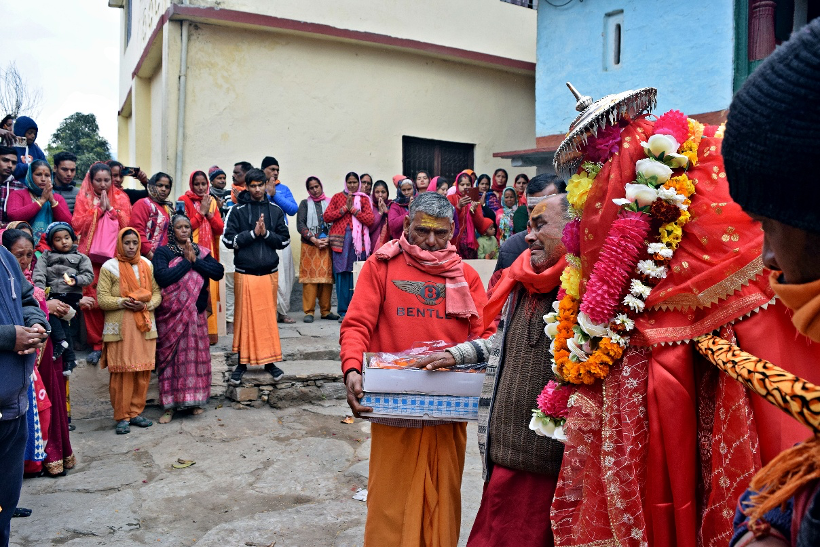
Figure 1: The emotional moment of Padmāvatī’s farewell from Gabani Gaon, her maternal village (mait) (Photograph by Vineet Gairola, 2023).
In that moment, the ground beneath the procession felt charged with something more than devotion. As I stood among the villagers, I realized that the emotional intensity surrounding the Goddess could not be dismissed as symbolic excess or mere performance. Those tears of the Goddess and those of her devotees touched the ground—the ground of Garhwal Himalaya, and the ground of my work. I realized that those tears, the vulnerable bodies, the moving scene of the Goddess’s farewell, revealed a deeper grammar of experience that villagers themselves name as bhāva. The term is often translated as feeling, mood, or sentiment, yet none of these words quite captures its weight. Bhāva was not just personal; it moved between bodies, passing through the medium, the villagers, and the Goddess herself.
For me, as a psychologist conducting ethnographic fieldwork in the Garhwal Himalaya (see Figure 2), this moment became a quiet turning point. It reshaped the way I understood the relationship between emotional life and ritual practice. What I was witnessing was not simply devotion directed toward a distant deity. It was a relational field in which humans and deities encountered one another through embodied states of feeling. Bhāva, I slowly began to understand, lies at the center of the psychospiritual life of Garhwal and became my method of writing, sensing, listening, communicating, and last but not least, relating. Bhatia (2018) added that as a postcolonial researcher who is both insider and outsider, it is important to note that in ethnography, “a researcher’s self is not just shaped by the participant through intersubjective exchange but also the researcher makes emotional investments in his or her participant’s stories and their cultural world” (Bhatia, 2018, p. 278). Hence, “feeling” and “reflections in the field” are not “irrelevant,” rather “a source of knowledge” (Bhatia, 2018, p. 279).
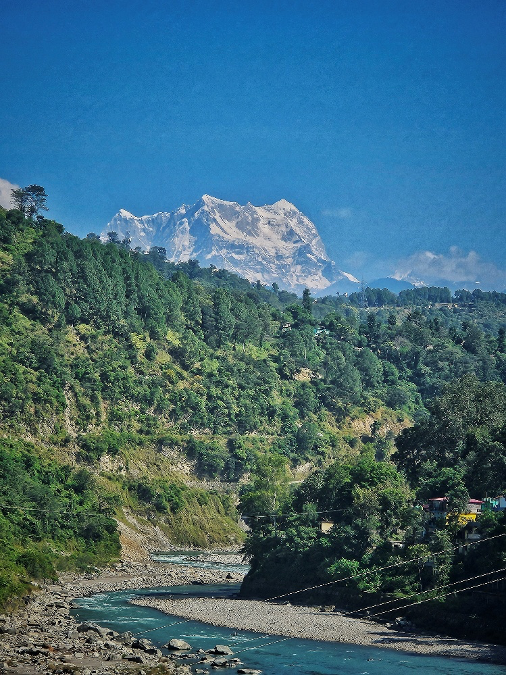
Figure 2: Chaukhamba peak visible from Agastyamuni, Kedar Valley in Garhwal Himalaya (Photograph by Vineet Gairola, 2023).
When I ponder about feelings, my field experiences in Garhwal Himalaya, and psychological anthropology, I often find myself going back to Carl Jung. Roger Brooke (2023) examined Jung’s dreams about Africa and how they reveal the biases of his European worldview, particularly his colonialist assumptions. Brooke analyzes Jung’s visits to Africa and New Mexico, exploring his dreams about them. Despite Jung’s theory on dreams, Brooke (2023) argues that Jung failed to apply it to his own dreams even decades later. While Jung believed that Africa would reveal the missing link in his personality, Brooke suggests, “what was invisible to Jung was not out there in Africa but in Jung’s way of seeing” (Brooke, 2023, p. 12). Brooke argues that colonialist attitudes influenced Jung’s thinking and theory of individuation. I would add further that Jung’s ambivalent emotions regarding his positionality led to this analytical indigestion, or rather, epistemic fracture. For students of psychology and anthropology, it is quite crucial to repair this fracture. I did too, by not shying away from the emotional and the relational in the field.
Coming back to the scene I unfolded through words at the start of this blog, moments like those also raise a larger disciplinary question. Experiences of deity possession or divine embodiment have long occupied an uneasy place between psychology and anthropology. Within many strands of psychology and psychiatry, deity possession has often been approached through the language of altered states, dissociation, or pathology (see Budden, 2008). From this perspective, the deity becomes secondary; the analytical focus rests primarily on the individual mind and its deviations from normative psychological functioning. Anthropology, particularly sociocultural anthropology, has tended to move in a different direction. Rather than locating deity possession within the pathology of the individual, anthropologists have often approached it as a meaningful cultural practice (see Sax, 2002). Ritual possession becomes a site of attunement through which communities articulate cosmology, morality, and social relations.
In the ritual worlds of the Garhwal Himalaya, however, deity possession rarely appears to villagers as either pathology or mere symbolism. Instead, it unfolds through what they call bhāva—an embodied state of devotional feeling that arises within relationships between humans and deities. Bhāva complicates the boundary between the psychological and the cultural. It is neither simply an internal emotion nor only a symbolic expression. Rather, it is a relational state cultivated through ritual labor, collective movement, music, and shared expectation. I walked in many such yātrās as I described above, namely those of Kunwarikā, Caṇḍikā, and Padmāvatī, from 2021 to 2023, for thousands of kilometers, barefoot and fasting (see Figure 3).
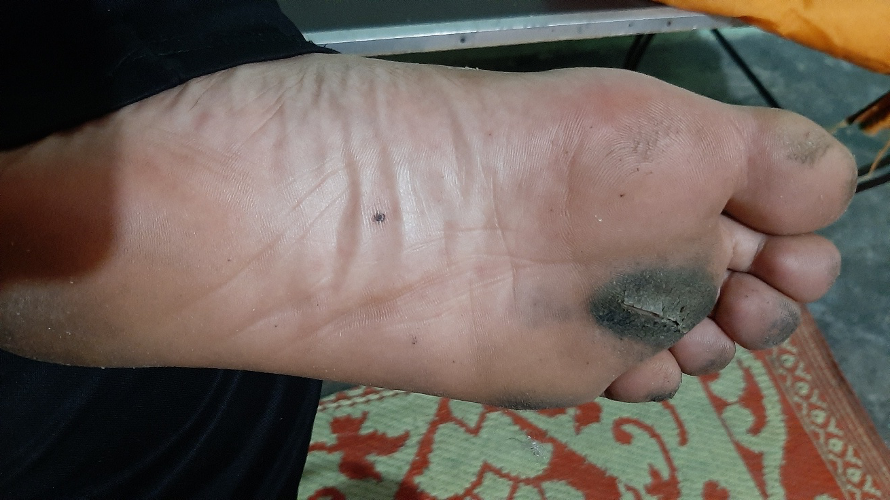
Figure 3: Thorns kissed my feet, a way of absorbing data through the body in Caṇḍikā’s ritual journey (devarā yātrā) (Photograph by Vineet Gairola, 2022).
What slowly became clear during the devarā yātrās was that bhāva is not merely a feeling that arises within an individual body; it emerges within a shared ritual field (see Figure 4). The divine embodiment experiences of mediums and devotees, the rhythm of the ḍhol–damāuñ drums, the chants and sounds of bhañkoras (copper wind instruments) that echoed mountainous valleys, and the collective anticipation of the villagers together generate a space in which psychological states take shape relationally. Divine embodiment, in this sense, is not an isolated event occurring within a single person but a moment that unfolds through many bodies, sounds, and gestures moving together. Bhāva provides a language for understanding this process. It points to a form of emotional attunement cultivated through ritual labor: fasting, walking barefoot, singing, remembering histories, and waiting for the deity’s presence. For a psychologist conducting ethnography, this insight gradually shifted the analytical frame. Rather than asking what happens inside the mind of an individual embodying a deity, the more compelling question became how certain ritual environments allow particular forms of experience to emerge collectively. Bhāva, therefore, offers a methodological clue for psychological anthropology: it invites us to consider psychological life not only as an internal process but as something that arises through relationships between people, between bodies and landscapes, and between humans and the deities with whom they live.
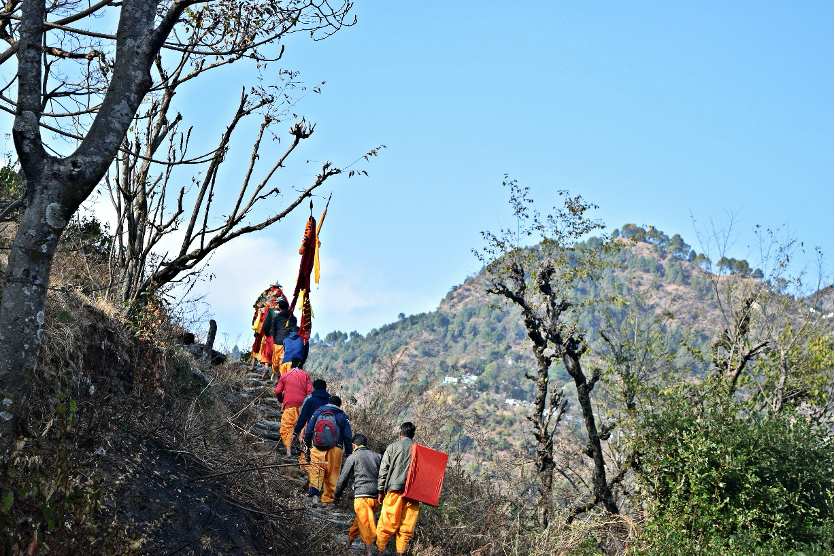
Figure 4: The troupe walking together with the Goddess: Devarā yātrā of Padmāvatī (Photograph by Vineet Gairola, 2023).
When I think back to that winter morning in the Kedar Valley, to the moment when Padmāvatī’s tears fell to the ground (through her medium) as villagers and devotees with teary eyes bid her farewell, the scene still resists easy explanation. It would be simple to describe it as belief, symbolism, or līlā (divine play). Yet standing there among the villagers, what felt most evident was the shared emotional atmosphere that held everyone together. In places like Garhwal, bhāva already names a relational psychology in which emotion, devotion, and presence are inseparable.
References
Bhatia, S. (2018). Decolonizing psychology: Globalization, social justice, and Indian youth identities. Oxford University Press.
Brooke, R. (2023). Jung’s fantasies of Africa and the individuation process, and Africa’s healing of analytical psychology. In M. Carter & S. A. Farah (Eds.), The spectre of the other in Jungian psychoanalysis: Political, psychological and sociological perspectives (pp. 11–27). Routledge.
Budden, A. (2008). Pathologizing possession: An essay on mind, self, and experience in dissociation. Anthropology of Consciousness, 14(2), 27–59. https://doi.org/10.1525/ac.2003.14.2.27
Gairola, V. (2026). Bhāva and rasa as forms of spiritual resilience: Embodied devotion and transformation through the Durgā Saptaśatī. In P. Rodrigues (Ed.), Re-mystifying the Devī Māhātmyam: From mythic texts to life (forthcoming). Springer Nature.
Gairola, V., & Ranganathan, S. (2026a). Drumming the deity to life: Sound, divinization, and the return of Bagḍwāl Devtā in the Garhwal Himalaya. International Journal of Hindu Studies (forthcoming).
Gairola, V., & Ranganathan, S. (2026b). Emotion and deity possession in the worship of a mountain goddess. In G. Misra et al. (Eds.), Mental health and social transformation: Cross-cultural perspectives on well-being (forthcoming). Springer.
Gairola, V., & Ranganathan, S. (2025a). The rhythms of tradition: Understanding ḍhol sāgar and drumming knowledge in Garhwal Himalaya, North India. Journal of Dharma Studies, 8, 443–468. https://doi.org/10.1007/s42240-025-00208-0
Gairola, V., & Ranganathan, S. (2025b). Linking body, memory, and divine embodiment: Two cases of ritual healers from Garhwal Himalaya. Journal of Dharma Studies, 8, 95–118. https://doi.org/10.1007/s42240-024-00194-9
Gairola, V., & Ranganathan, S. (2023a). The divine as a child and the mother goddess: On history and practice of Kunwarikā Devī worship in Garhwal Himalaya. HIMALAYA, 42(1), 98–117. https://doi.org/10.2218/himalaya.2023.6626
Gairola, V., & Ranganathan, S. (2023b). Worship in transition: An encounter with the Rājrājeshwarī Devī of the Garhwal Himalaya. HIMALAYA, 42(1), 118–140. https://doi.org/10.2218/himalaya.2023.6678
Sax, W. S. (2002). Dancing the self: Personhood and performance in the Pāṇḍav Līlā of Garhwal. Oxford University Press.

Vineet Gairola is a Ph.D. candidate in Psychology (thesis submitted) at the Indian Institute of Technology, Hyderabad, researching the ritual journeys of mountain Goddesses and the transformative experience of bakkyās (oracles) in the Garhwal Himalaya. Vineet has received 23 awards, delivered 28 presentations at international conferences, and published 49 works, including book reviews, chapters, and articles. He is the Book Review Editor of Springer’s Journal of Dharma Studies (2025-Present), an International Relations Committee (IRC) member of APA Division 39, and a Student Development Committee member of APA Division 29. He was selected as one of the top 40 emerging psychologists in the Emerging Psychologists’ Programme (EPP) in the International Congress of Psychology (Prague, 2024).
Leave a Reply