Welcome to the third of the Tracing the Interdisciplinary ENPA Blog Series. Lan Feng engages with interdisciplinary dialogue between psychotherapy and social anthropology to interpret mental distress in war discourse across cultures.
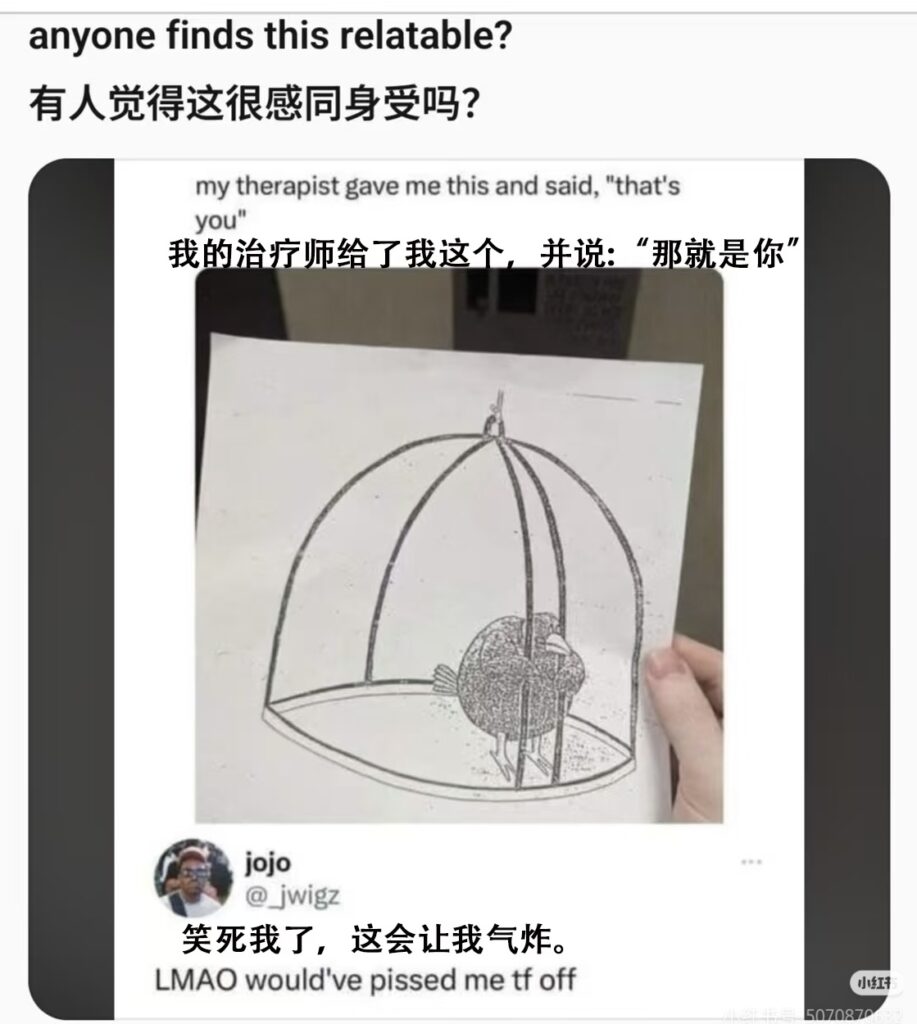
Image: A screenshot from Chinese social media, Little Red Book. The image invoked the meaning-making among Chinese youth in relation to hopeless stuckness, which has also been interpreted by a few psychotherapists as cognitive impairment. From an anthropological perspective, this parallel of meanings is telling in a phenomenological way, regarding ontological reality, intersubjectivity between patients and caregivers, between patients and healers, as well as its potential contribution to understanding suicidal intention among Chinese youth.
In this unorthodox exploration of interdisciplinary dialogues, I, as a PhD student in social anthropology, collaborate with a Chinese clinical psychotherapist based in urban China, reflecting on the power dynamics of research relationships, the relevance of psychologically informed ethnographic questions in studying mental distress, the clinical insights offered through a mini-case study, and the interplay among these elements.
One morning in early March, a long-acquainted interlocutor in China shared a message with me via WeChat, with wry humour, that the UK government was potentially sending an aircraft carrier to the war zone, the Middle East, indicating my safety might be at risk in the foreseeable future, should the UK be drawn into the conflict.
My positionality, particularly concerning my Chinese nationality, UK training as an anthropologist, status as a PhD candidate, and gender as a woman, has played an unexpectedly unsettling role, posing a bittersweet tension in my research relationships during my fieldwork in the Chinese psy-industry. This tension has inspired one of the central reflections and arguments in my methodology. Unexpectedly, on that morning, our conversation began with war and ended with my provoked query about the implication of the ongoing conflict for illness experiences among Chinese youth, giving rise to an interdisciplinary dialogue between anthropology and psychology in miniature.
In fact, the goodwill message seemed to unsettle me, and I replied reactively, trying to end the conversation as soon as possible. By then, I had been limiting myself to the latest war-related news because a few Middle Eastern teaching staff and students I know on campus were affected by the tragedy, and witnessing its devastating impacts on them pained me. One wonders why a harmless message triggered my defensive reaction, a kind of question I have become attuned to asking throughout my fieldwork. I am neither a psychologist nor a psychotherapist, which is precisely the advantage – that is, the different aspects anthropology can bring to interdisciplinary collaboration, in terms of context, environment, and situatedness.
It suddenly hit me: as I live in London, study and teach on campus, and feel close to my supervisor, colleagues, and students, therefore my experience is relational and relevant to them. In contrast, my interlocutor resides in China, viewing the UK military situation through the lens of Chinese public media discourse, which both explains and excuses a touch of irony in that message. The process of reflexivity, brief as it was, enabled me to ask more ethnographic questions – apart from the one I just asked myself – and made possible a conversation, despite its limitation, for understanding the relationship between the discourse of war and illness experience of Chinese young patients, who are diagnosed with bipolar disorder, based on a small sample of clinical encounters from a Chinese psychotherapist.
Act One
Anthropologist (A): What impacts would the ongoing conflicts in the Middle East have on mental patients in urban China? Is there any?
Psychotherapist (P): Based on my personal observation of clinic patients and private clients, there are already symptoms and diagnoses to which the conflicts are irrelevant; however, the war can exaggerate certain kinds of symptoms.
A: What do you mean by symptoms?
P: I am talking about the singularity of symptoms rather than a cluster. I will use major symptoms of bipolar disorder as an example in relation to war impacts, but this does not mean only bipolar patients are affected by discourse on violence.
A: Why do you prefer bipolar over other mood disorders, since they are all regarded as clusters of symptoms according to the DSM?
P: From my perspective, mood disorders are an assemblage of symptoms, or rather a syndrome. Yet bipolar tends to be more mysterious than depression. Bipolar is like a kind of Chinese traditional herbal decoction, containing substances such as oroxylum seeds (⽊蝴蝶) and astragalus (⻩芪), among other ingredients. You do not know which component is actually performing. Bipolar is well-known for its mood swings and psychotic symptoms, such as visual hallucinations and hearing voices. I am going to focus on the ups and downs of mood swing.
It is an opportune moment to introduce the explanatory model used here. The Chinese clinician plays multiple therapeutic roles in the private sector of the mental health system, with a training background in both psychodynamics and biological psychiatry, and as an entrepreneur psychotherapist and clinical psychologist at a private hospital in urban China. His interpretation of mood disorders is not only culturally and socially informed but also shaped by his professional trajectory, therapeutic approach and traits of clinical cases.
Act Two
P: War is the continuation and extension of politics; politics is a congregation of socio-economic relationships and power dynamics. They are reflected in our family relationships, or rather, family politics, the ramifications of which can be a source of mental illness. Additionally, war represents conflict, crisis, and destruction. When we break down the word “crisis (危机, Wei Ji)”, we see that behind ‘danger (危, Wei)’ there is also ‘opportunity (机, Ji)’, like two sides of the same coin. Therefore, war signals a fundamental transformation. This intensity of transformation is equivalent to establishing an entirely new order of the world that completely overturns the old one. It is fatally enticing though.
Now we are bringing this metaphor into understanding illness experience: young people with bipolar disorder, especially those with suicidal intention, are constantly immersed in internal ‘wars’, confronted with the choice between living or dying. Against this agony of mental torment, patients long for change, and therefore for ‘war’. Moreover, the pervasive Buddhist ideas of reincarnation can reinforce the hope for post-war life, where the destruction of this life is seen as paving the way for the glory of the next.
A: You seem to use the metaphor of war as an explanatory model for the ‘ups’ symptom of bipolar disorder rather than what we set out to discuss, implications of war.
P: Yes, I had just begun to talk about the hypothetical impact of war on those living through it …
My intention in presenting part of the conversation between a psychotherapist and myself is not to explore how a clinician interprets the intersection of potential war impact and mental illness among Chinese patients, but rather to dissect the process of knowledge production between an anthropologist and a psychotherapist, which is unpredictably meaningful. From my perspective, the employment of war serves as a framework in therapeutic narrative to explain the cause of mental distress, while metaphors of ‘decoction’ and ‘ingredients’ teaming up with Buddhist ideology tends to unravel the social, cultural, psychological and biological meanings of illness experiences. All of this is paramount for anthropological readings of mental distress or a diagnosis.
Nevertheless, this kind of knowledge production is contingent upon the nature of the research relationship and reflexivity on both sides. At times, the clinician brings not only cases but also ethnographic insights. Meanwhile, anthropology provides tools, including but not limited to, the ability to forage whatever takes place as data and to situate perspectives in social context and historical trajectory. In this mini-case study, my aim is to foreground the possibility of posing ethnographic questions to both our interlocutors and ourselves, toward subsequent fruitfulness.
Author Bios (in alphabetical order)
Lan Feng is a PhD candidate in Anthropology at SOAS University of London, affiliated with the Centre for Anthropology and Mental Health Research in Action (CAMHRA). She is interested in the intersection of anthropology and psychology, especially in relation to ethnographic approaches to mental health, knowledge production, and interdisciplinary collaboration.
Zecheng Wang is an independent psychotherapist practicing in urban China, with a professional background in biomedical psychiatry, clinical psychology, and psychotherapy. He has worked in various settings, including hospitals, schools, and enterprises, engaging with psychoanalytic and psychodynamic approaches, as well as rehabilitation techniques for mental distress and mood disorders.
Leave a Reply